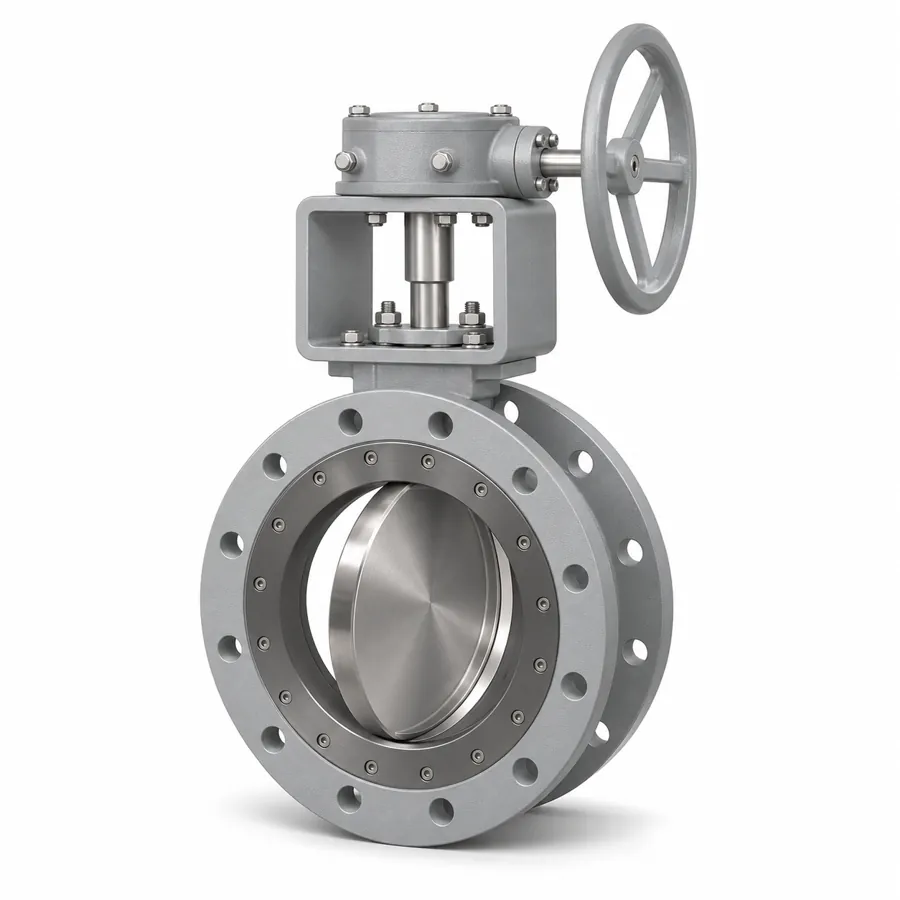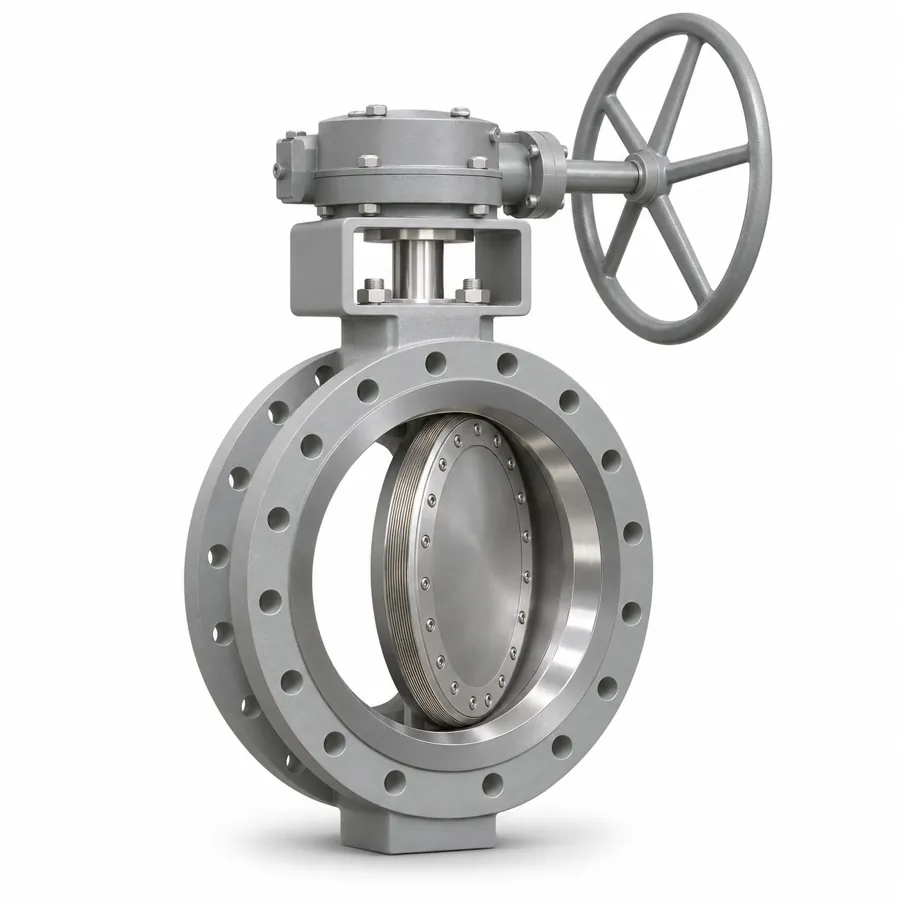
Double offset and triple offset butterfly valves are both called high-performance butterfly valves, and both are used where a standard rubber-lined butterfly valve is not good enough. The difference is in how the disc meets the seat. A double offset valve usually has a soft seat that the disc presses into. A triple offset valve has a metal seat, and the disc does not rub on it until the moment it closes. That one difference decides temperature limits, leakage behaviour and how the valve must be operated.
This guide explains the offsets in plain terms and shows how to choose between the two.

The short answer
- Choose a double offset valve for general process service at moderate temperature, where a PTFE-type soft seat is acceptable: water, chemicals, hydrocarbons, HVAC and utility lines. It gives tight shut-off with a simpler seat design.
- Choose a triple offset valve for high temperature, steam, abrasive or critical isolation duty, where a soft seat would not survive or where a metal seat is required by the specification.
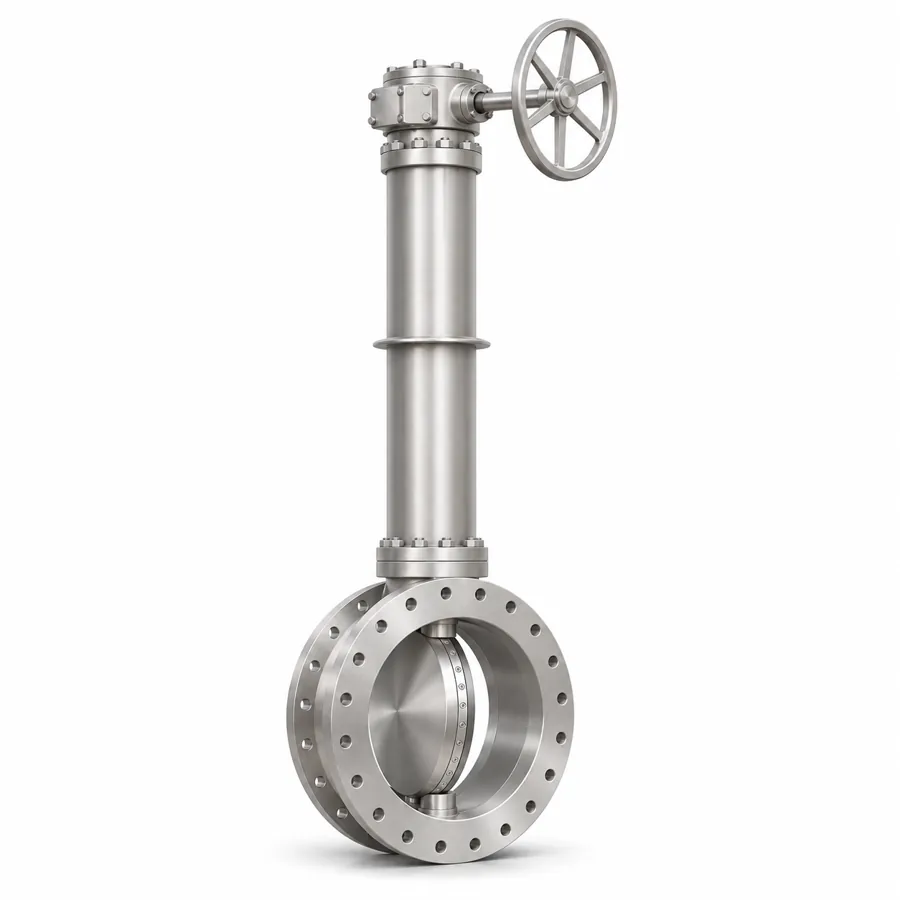
- For LNG and other cryogenic service, use a cryogenic triple offset valve with an extended bonnet.
What the offsets are
Start with a simple concentric butterfly valve. The shaft passes through the centre of the disc and the centre of the pipe, and the disc edge rubs against a rubber liner all the way round every time the valve opens or closes.
- First offset. The shaft is moved behind the sealing face of the disc. The seal now runs in an unbroken circle, with no shaft holes passing through it.
- Second offset. The shaft is also moved to one side of the pipe centreline. When the valve opens, the disc swings away from the seat with a cam action, so contact and wear last only for the first few degrees of opening. A valve with these two offsets is a double offset (double eccentric) valve.
- Third offset. The seat is machined as a cone, and the axis of that cone is tilted away from the pipe centreline. With this geometry, the disc seal ring does not touch the seat at all while the valve rotates; it makes contact only at the closed position. A valve with all three offsets is a triple offset valve.
Double offset vs triple offset at a glance
| Double offset | Triple offset | |
|---|---|---|
| Seat | Usually soft (PTFE or reinforced PTFE); metal or fire-safe versions exist | Metal to metal: laminated or solid seal ring against a metal seat |
| Disc-to-seat contact | Short rubbing at the start of opening and end of closing | No rubbing during rotation; contact only when closed |
| How it seals | Position-seated: the disc presses into the seat with an interference fit | Torque-seated: closing torque presses the seal ring onto the seat |
| Temperature | Limited by the soft seat material | High temperature and cryogenic designs available |
| Design standard (typical) | API 609 Category B | API 609 Category B |
| Typical services | Water, chemical, general hydrocarbon, HVAC, utility lines | Steam, refinery and petrochemical isolation, high temperature, LNG |
Seat design and leakage
A double offset valve with a soft seat can give very tight shut-off. Some manufacturers rate their soft-seated double offset valves to ANSI/FCI 70-2 Class VI, the strictest class in that standard. The weakness of the soft seat is temperature and erosion: PTFE softens as temperature rises, and solid particles or high-velocity flow can damage it.
A triple offset valve has no soft parts in the seal. The seal ring is either a stack of metal and graphite laminations or a solid metal ring. Because it is torque-seated, it can achieve tight shut-off in conditions where a soft seat would fail.
Leakage claims are model-specific. Different makers quote different standards: ANSI/FCI 70-2 classes, API 598 seat tests, or ISO 5208 / EN 12266-1 leakage rates. These are different tests with different media, pressures and acceptance criteria. When you compare offers, ask each supplier which standard and which class or rate applies, and in which flow direction. Many triple offset valves seal in both directions but have a preferred direction marked by an arrow on the nameplate.
Temperature and pressure
The seat sets the limit. As examples from manufacturers’ published data, soft-seated double offset valves are typically rated somewhere between about 180 °C and 260 °C, depending on the seat material and construction, and allowable pressure falls as temperature rises. Triple offset valves are commonly offered from cryogenic temperatures up to about 400–450 °C, and above about 425 °C they often need a special high-temperature construction.
Pressure class and maximum temperature are separate limits in a catalogue. The pressure a valve can hold at a given temperature follows the pressure-temperature rating of its body material and seat, so always check both together for your operating point.
Our own ranges are given in the last section.
Torque, operators and actuators
A double offset valve is position-seated: it seals when the disc reaches the closed position and presses into the seat. A triple offset valve is torque-seated: it seals because the operator applies a closing torque that holds the seal ring against the seat, including against line pressure.
This affects how the valve is operated. For a triple offset valve, the gearbox or actuator must deliver the closing torque given by the manufacturer for your pressure and flow direction, and the closing stop must be set as the manufacturer instructs. When you order a triple offset valve with an actuator, ask the valve supplier for the seating torque and confirm the actuator size against it.
Fire-safe requirements
Refinery and petrochemical specifications often ask for fire-safe valves. API 607 and ISO 10497 are fire type-tests: a valve design is exposed to fire and then checked for seat leakage, external leakage and operation. A fire-safe rating belongs to a tested design, not to a valve type, so ask for the type-test certificate that covers the design, size and class you are buying.
How to choose
- Clean or mildly corrosive fluid, temperature within the soft seat rating, no metal seat required: double offset.
- Steam, hot oil, high-temperature gas, or temperature above the soft seat rating: triple offset.
- Abrasive media or long periods without operation, where a soft seat could be damaged: triple offset.
- Critical isolation, or a project specification that asks for metal seats: triple offset.
- LNG, LPG, liquid ethylene and other cryogenic service: cryogenic triple offset with an extended bonnet that keeps the packing away from the cold zone.
- Water and general utility service without pressure class requirements: a concentric resilient-seated butterfly valve may be enough, and is not covered on this site.
High-performance butterfly valves we make
- Double offset butterfly valve: Class 150 and Class 300 (Class 600 in selected designs), Class 150 wafer DN 40 to DN 1500 and Class 300 wafer DN 50 to DN 600, WCB, CF8, CF8M, CF3 and CF3M bodies, soft seat rated −30 °C to 180 °C. Wafer, lug, double-flanged and weld-end bodies.
- Triple offset butterfly valve: metal-seated, Class 150–600, NPS 3 to NPS 48 (DN 80 to DN 1200), WCB, CF8M and WC6 bodies, maximum temperature 425 °C. Double-flanged, lug and wafer bodies.
- Cryogenic triple offset butterfly valve: stainless steel, Class 150–300, NPS 2 to NPS 24, extended bonnet. Fire-safe design to API 607 is available on request.
Design to API 609 and testing to API 598 are applied on request and confirmed in the quotation. Browse all high-performance butterfly valves. For pneumatic or electric actuated packages, see our sister site for control and automated valves.
What to send for a quotation
- Valve type (double offset, triple offset or cryogenic) and quantity for each size.
- Size (NPS or DN) and pressure class.
- Body style: wafer, lug, double-flanged or weld-end, and flange standard.
- Body, disc and seat materials, or the medium if you want us to propose them.
- Operating pressure, minimum and maximum temperature, and flow direction.
- Required leakage standard and class, and any fire-safe requirement.
- Operation: lever, gearbox or actuator, and the control signal if actuated.
Send the list with your enquiry and we will reply with a quotation and the matching datasheet.