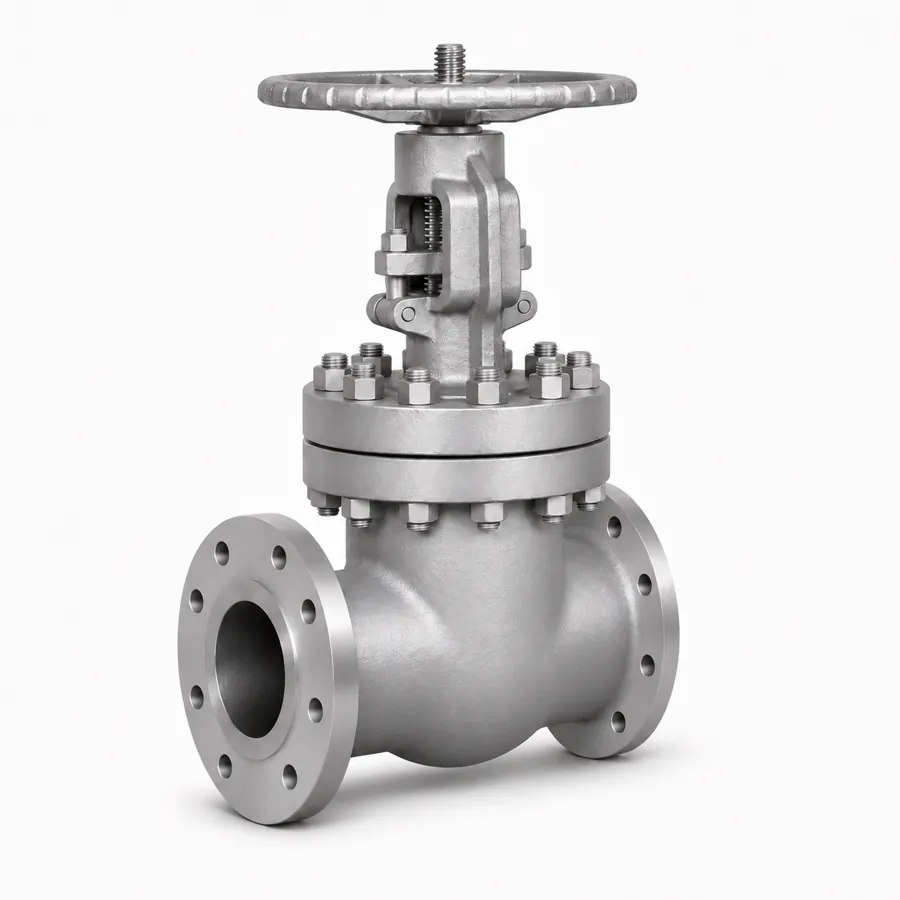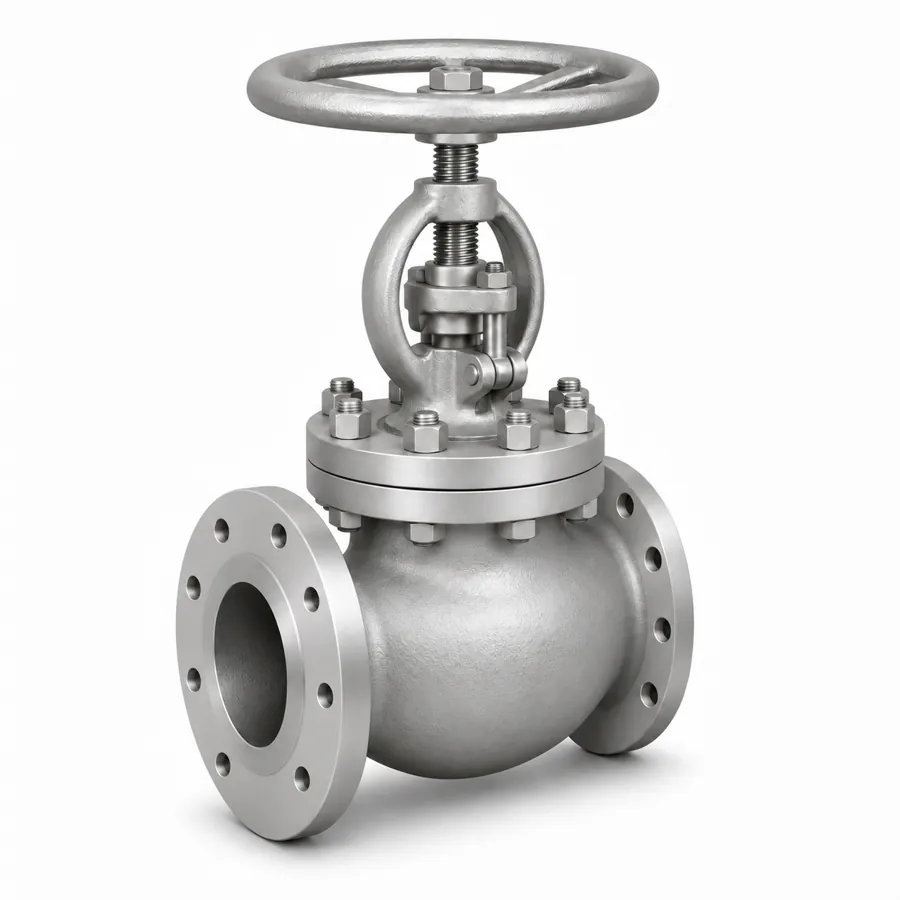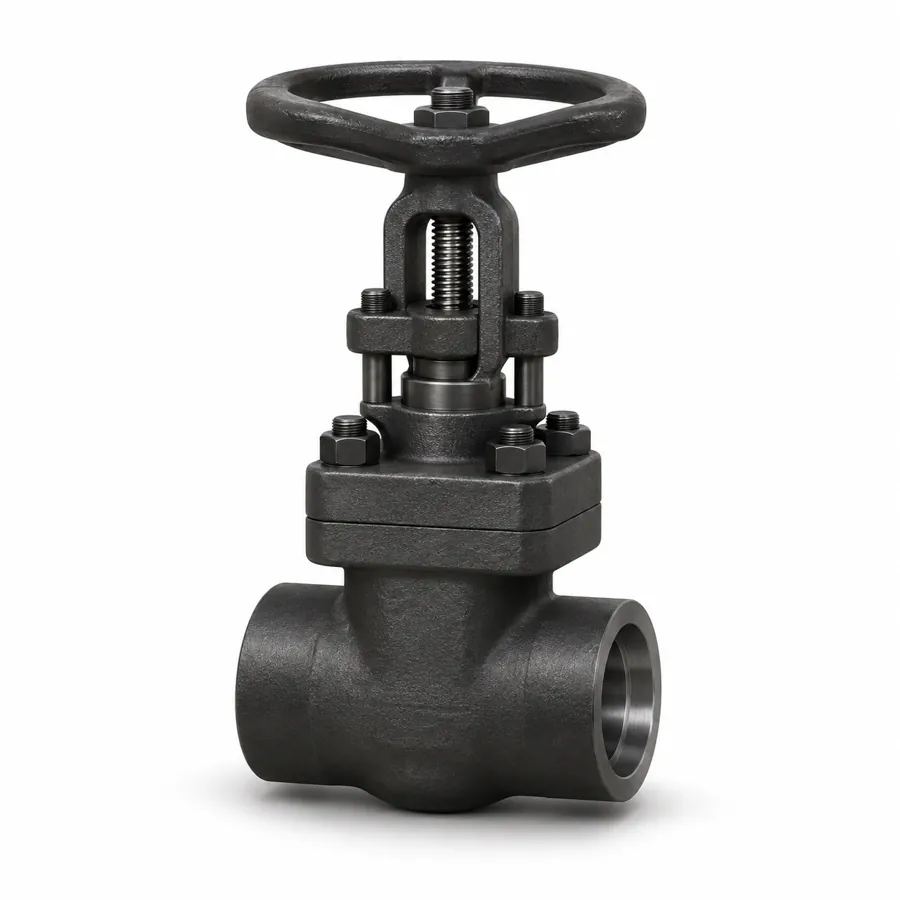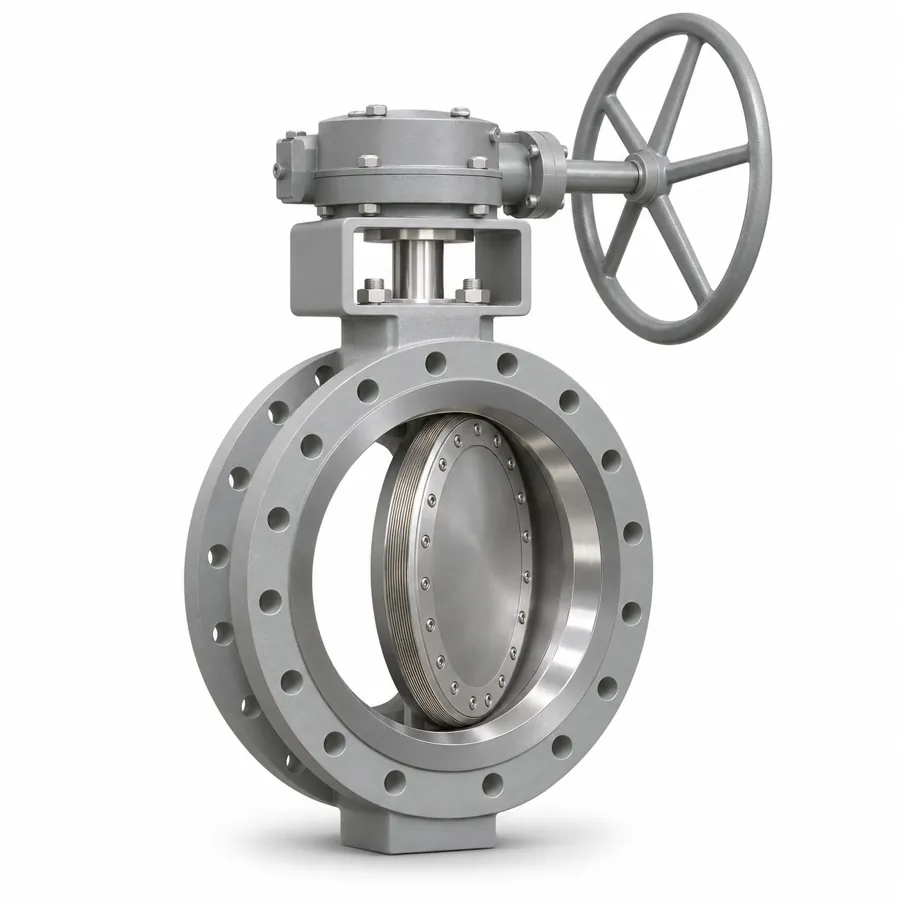
A gate valve and a globe valve can look alike from the outside: a steel body, a bonnet, a stem and a handwheel. Inside they work in very different ways. A gate valve is built to be fully open or fully closed. A globe valve is built to control flow, and it also shuts off well. Choosing the wrong one costs either energy, through extra pressure drop, or seat life, through throttling with a valve that was never meant for it.
This guide explains the differences that matter when you write a purchase specification or check a quotation.
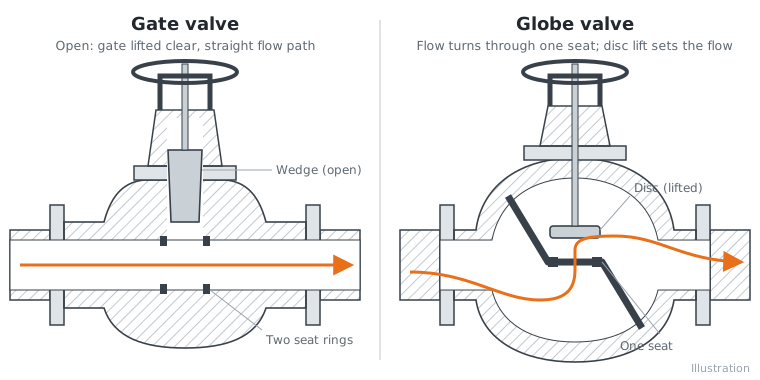
The short answer
- Use a gate valve for isolation: lines that are normally fully open and are closed only for maintenance or emergencies. When open, the gate is out of the flow path, so pressure drop is very low.
- Use a globe valve where you need to regulate or throttle flow, or where the valve is opened and closed often. The flow turns inside the body, so pressure drop is much higher.
- For high-pressure steam and feedwater, a Y-pattern globe valve gives globe-valve control with a lower pressure drop than a standard globe valve.
Gate valve vs globe valve at a glance
| Gate valve | Globe valve | |
|---|---|---|
| Main job | On/off isolation | Throttling and on/off |
| Flow path when open | Straight through, gate fully out of the flow | Flow changes direction around the seat |
| Typical equivalent length, fully open (L/D) | About 8 (some references give 13) | About 340 (straight pattern); about 160 for Y-pattern |
| Partly open operation | Not recommended | Designed for it |
| Stroke | Long: the gate must clear the bore | Short |
| Closing force | Wedge pushed between two seats | Disc pushed onto one seat, along the stem axis |
| Flow direction | Usually either direction | Marked by an arrow on the body |
| Typical services | Isolation in oil and gas, refinery, petrochemical and power piping | Steam, feedwater, fuel oil, drains, vents, chemical feed |
The L/D figures are typical published values for fully open valves, taken from engineering references. Use them to compare valve types, not to size a system. For hydraulic calculations, use the flow coefficient (Cv or Kv) of the valve you are buying.
Flow path and pressure drop
In a gate valve, the gate (or wedge) moves up into the bonnet when the valve opens. In the fully open position it is completely out of the flow stream, and the bore is close to the pipe bore. Fluid passes straight through.
In a standard globe valve, the fluid enters below or above a horizontal seat, passes through the seat opening and turns again to leave the body. The U.S. Department of Energy’s fluid flow handbook describes this path as two or more right-angle turns. These turns are the reason a globe valve controls flow well, and also the reason it has a much higher pressure drop.
The difference is large. A common reference table gives a fully open gate valve an equivalent length of about 8 pipe diameters and a straight-pattern globe valve about 340. In a long pumped line, or a line with many valves, choosing globe valves where gate valves would do adds pumping cost for the life of the plant.
Throttling: why a gate valve should not be used partly open
A gate valve does not give useful flow control. Most of the change in flow happens in the last part of the stroke, close to the closed position. When a gate valve is left partly open:
- Fluid passes at high velocity through the small gap under the gate and wears the gate and seat faces. Once the seats are damaged, the valve no longer shuts off tightly.
- The partly open gate tends to vibrate in the flow, which damages the guides and the stem.
A globe valve is designed for this duty. The disc moves toward or away from the seat, and the flow changes in proportion to the lift, so the operator can set a flow and repeat it. For severe throttling, ask for hardfaced seat and disc surfaces (for example Stellite), and confirm the trim with the supplier.
If the job is automatic, continuous control of flow, pressure or temperature, a control valve with an actuator and positioner is the right product, not a manual globe valve.
Shut-off and flow direction
A wedge gate valve seals by pushing a tapered wedge between two seat faces. A globe valve seals by pushing a disc straight down onto one annular seat, with the stem force acting along the closing axis.
Engineering references do not agree on which type seals better in general. Some steam references say globe valves are less likely to leak; other references say gate valves give better tight shut-off. In practice, tightness depends on the seat design, materials and condition of the valve you buy. If tightness matters, specify the test standard and leakage acceptance in the order, for example a seat test to API 598, and ask for test records.
A globe valve has a correct flow direction, marked by an arrow on the body. The most common arrangement is flow under the disc. Some manufacturers recommend flow over the disc for certain steam duties, so that line pressure helps hold the disc on the seat. Always install a globe valve as the arrow and the manufacturer’s instructions show.
Stroke, operating effort and space
- Stroke. A gate valve must lift the gate clear of the bore, so its stroke is long and it needs more handwheel turns to open or close. A globe valve has a much shorter stroke and opens and closes faster.
- Operating effort. In a globe valve, line pressure under the disc creates an axial load on the stem, which the operator has to overcome when closing. In larger sizes and higher pressure classes, this is why gear operators, bypass valves or balanced designs are used.
- Size and weight. Globe valves are generally heavier than other valve types for the same flow duty, and large globe valves are less common than large gate valves. For big lines that only need isolation, a gate valve is usually the practical choice.
Y-pattern globe valves
In a Y-pattern globe valve, the stem and seat are inclined to the pipe axis. The flow changes direction less, so pressure drop is lower than in a standard (T-pattern) globe valve. One engineering reference gives a Y-pattern globe valve an equivalent length of about 160 diameters, against about 340 for a straight-pattern globe valve.
Y-pattern globe valves are common in high-pressure steam, boiler feedwater and drain service, usually with pressure seal bonnets and butt-weld ends. See our Y-pattern globe valve.
Standards you will see on a datasheet
| Standard | What it covers |
|---|---|
| API 600 | Bolted bonnet steel gate valves with flanged or butt-weld ends, for refinery and related service |
| API 623 | Bolted bonnet steel globe valves with flanged or butt-weld ends |
| BS 1873 | Steel globe and globe stop and check valves (British standard, still widely quoted) |
| API 602 | Compact steel gate, globe and check valves, NPS 4 and smaller |
| ASME B16.34 | Pressure-temperature ratings, wall thickness, materials and testing of steel valves |
| ASME B16.10 | Face-to-face and end-to-end dimensions, so valves can replace each other in the line |
| API 598 | Inspection and pressure testing, including shell and seat tests |
Before you compare two quotations, check that they refer to the same design standard, the same face-to-face standard and the same test standard. A lower price often means a different standard.
Gate and globe valves we make
All are cast or forged steel valves rated in ASME classes or PN. Design and test standards are applied on request and confirmed in the quotation.
- Cast steel gate valve: OS&Y bolted bonnet wedge gate, Class 150–2500, NPS 2 to NPS 48 (Class 150), WCB, WC6, WC9, C5 and stainless steel, flanged or butt-weld.
- PN-rated cast steel gate valve: PN 16 to PN 420, DN 15 to DN 1000.
- Forged steel gate valve: DN 15 to DN 50, Class 150–2500 including Class 800, socket-weld, threaded or flanged.
- Pressure seal gate valve: Class 600–2500, DN 50 to DN 600, for high-pressure steam and process lines.
- Cast steel globe valve: Class 150–2500, DN 15 to DN 400, bolted bonnet or pressure seal bonnet.
- Forged steel globe valve: DN 15 to DN 50, for instrument, drain, vent and small process lines.
- Pressure seal globe valve and Y-pattern globe valve for power and steam service.
- Bellows seal gate and globe valves where the stem must be sealed by a metal bellows.
Browse all gate valves and globe valves. Larger cast steel valves can be supplied with a bevel gear operator. For electric or pneumatic actuation, see our sister site for control and automated valves.
What to send for a quotation
- Valve type (gate or globe) and quantity for each size.
- Size (NPS or DN) and pressure class (ASME Class or PN).
- Body material and trim, for example WCB with 13Cr trim, or WC6 with Stellite seats.
- End connections: flanged RF or RTJ, butt-weld (with pipe schedule), socket-weld or threaded.
- Medium, operating pressure and temperature, and whether the valve will throttle.
- Operation: handwheel or gear operator, and any actuation needed.
- Design, face-to-face and test standards required by your project, and any inspection or documentation requirements.
Send the list with your enquiry and we will reply with a quotation and the matching datasheet.